
GEOPOLITICS

Djibouti’s geopolitical balancing act

The geostrategic curse

Djibouti faces a unique set of challenges that warrant attention. While some of these challenges are common to other parts of Africa, its geostrategic location, strong military presence of superpowers, and specific regional dynamics distinguish it from other countries in the region.

Red Sea tensions

The tiny African nation hosts the largest number of military installations in the world, cramped into a territory the size of New Hampshire or the Italian island of Sardinia.

In fact, the territory where these bases are situated is even smaller, as they are all elbowing each other within the confinement of Djibouti City.
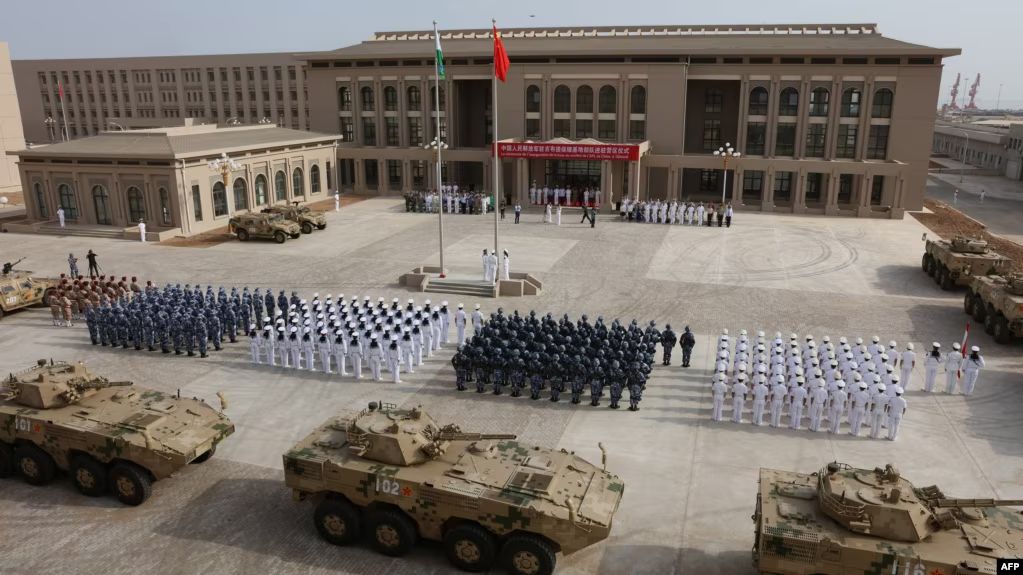
People's Liberation Army base in Africa
People’s Liberation Army base in Djibouti,
China’s foothold in Africa

Djibouti is located by the Bab-el-Mandeb Strait, which is the main route that connects European waters with the Arabian Sea.

About 12% of the global seaborne trade and around 10% of the world’s oil passes through this waterway each year, including the majority of Asian trade with Europe and much of the oil from the Middle East.

The tiny nation also serves as a gateway to landlocked countries in the Horn of Africa (most significantly neighboring Ethiopia).

Its geopolitical significance attracts the interests of multiple regional and international actors, leading to complex power dynamics and potential tensions.

Djibouti hosts military bases of several foreign powers. The presence of these military forces adds a layer of complexity to the geopolitical landscape and may contribute to both stability and potential volatility. See satellite image below.

  • The China and Japan both have their only permanent overseas military base situated in Djibouti. The Chinese military base (near the Doraleh Multi-Purpose Port) and the American military base are situated in close proximity to each other. The distance between these two bases is about 5 to 6 kilometers (3 to 4 miles).
  • Camp Lemonnier is the primary base of operations for the United States Africa Command in the Horn of Africa. In 2013, the base underwent significant expansion and it houses 4,000 troops.
  • France maintains multiple bases in Djibouti when the territory gained its independence in 1977. La Base Aérienne 188 (BA 188), known as ‘Colonel Émile Massart’, is part of Djibouti International Airport. It provides support for French military operations in the region, and works alongside Djiboutian civil authorities, to ensure the coordination of international air activity in Djiboutian airspace. Other military personnel is based in Heron district.
  • Italy has its own military support base, ‘Amedeo Guillet’, located south of Camp Lemonnier, near the city of Loyada, 7 kilometers from the border with Somalia. It can accommodate up to 300 people.
  • NATO and the European Union, as well as other European countries – including Germany, the United Kingdom and Spain – rely on the existing military bases of their allies.
  • India has cemented defense ties with Japan, securing access to the port.
  • Saudi Arabia has laid the groundwork for a military base in Djibouti.
  • Russia and UAE were vying to establish a more permanent presence in Djibouti, but their attempts have been thwarted.

Djibouti shares a maritime border with Yemen, a country grappling with a complex internal conflict. The ongoing conflict in Yemen, involving various factions and international interventions, has had spillover effects in the region, including Djibouti.

The proximity to Yemen adds an extra layer of geopolitical complexity and potential security challenges to Djibouti’s landscape.

Djibouti’s dependence on China has shaped its economic landscape. Its current economic challenges (large informal economy, endemic high poverty and unemployment, arid climate) give rise to concerns that strategic infrastructure could fall under the control of foreign entities.

Djibouti’s dominant ruling party has been in power for an extended period. The political landscape lacks robust political pluralism and opposition representation, affecting the transparency and accountability of the government.

Military Bases in Djibouti: a Crowded Field
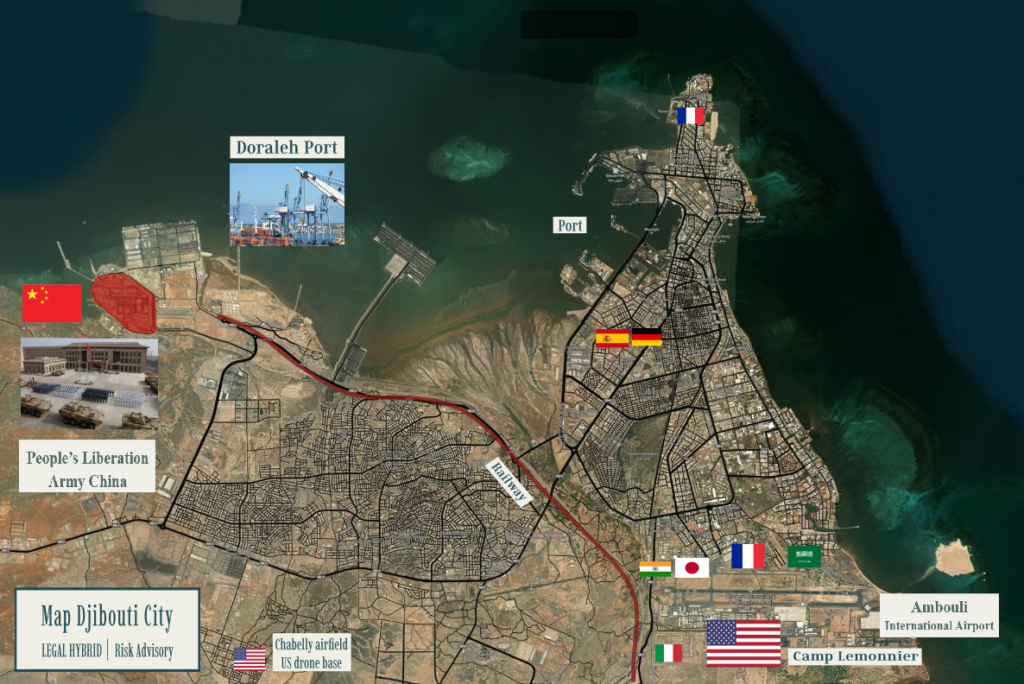
Djibouti guards the entrance to the Red Sea and thus the Suez Canal. It is the most militarized country in the world.

Satellite imagery of the military bases in Djibouti (source: Legal Hybrid | OpenStreetMaps | August 2023)